

Table Contents Page: T11
Anatomage Table 11 Update: The Full List of Added Content and Features (2024)
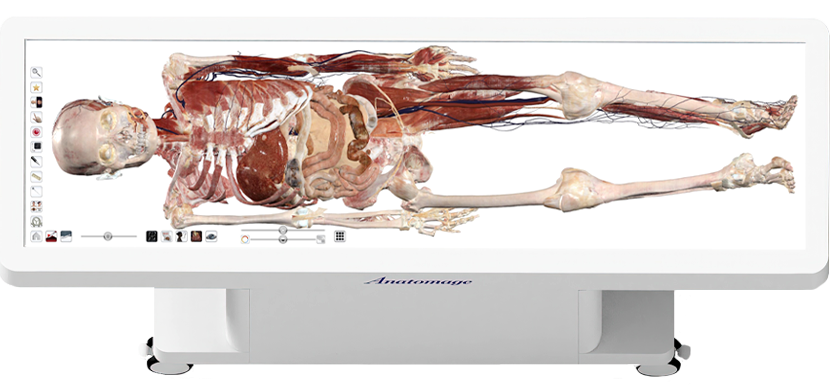
For over a decade, Anatomage has continuously expanded and refined the content of the Anatomage Table, delivering the most advanced reconstructions of real human bodies, uniquely augmented by dynamic simulations in functional anatomy and clinical procedures. Each annual update builds on the previous generation, adding new cadavers, real-anatomy-based physiology, clinical procedures, pathological cases, and interactive learning experiences designed for medical education and training.
Exploring real-time physiology in cadavers once seemed impossible — until now. The latest Anatomage Table 11 upgrades transform how physiology is taught and learned. These advancements make Anatomage Bodies function more like living human bodies than ever before.
Anatomage Table 11: New Content and Features
Release date: 2024
Cadavers Updates
Improved Anatomical Accuracy
- Victor: Musculoskeletal Visual Improvements
- Vicky: Musculoskeletal visual improvements, increased cardiovascular, nervous, and lymphatic system detail and accuracy,
- Hans: Additional detailed structures added to the head and neck, including TMJ ligaments, laryngeal structures, salivary glands, and cranial meninges.
New Content and Tools
Monkey
Addition of the world’s first fully segmented non-human primate. Scan number 257 within the Case Library contains the whole body of a female rhesus monkey.
Schematics
A new tool within the Layout Menu that simplifies complex vascular pathways through basic diagrams. These schematics are linked to the 3D body and can be used to display the connection between vessels and the bath of blood to and from the heart.
Updates to Existing Tools: Cadavers
New Branch Slider Bars
Users can now toggle between specific slider bars tailored towards different branch types (arteries, veins, nerves) and view specific presets for each type. This allows for easier creation of meaningful vascular views.
Complexity Levels
Users can now choose between a “basic”, “intermediate”, and “advanced” complexity level when viewing cadavers to better match the detail required for various course levels.
Custom Quiz Questions
Users now have the option to write their own long-form quiz questions. Ex: “Which organ is responsible for producing insulin?”
Ultrasound Simulation
Ultrasound now has its own icon within the Layout menu.
Ultrasound now has the option to select between convex, linear, and phased array probe models. .
Ultrasound now has the ability to view a black and white or color view.
New Settings: Cadavers
Modesty Mode
Users can now place the cadaver into a “Removed” or “Hidden” modesty mode, which will restrict reproductive organs from view in the loading screen, slider bars, and Volume Visibility menu.
Branch Selection Behavior
This new picking option assigns distinct colors to the vascular branches connected to the selected vessel, making it easier to follow the hierarchy of vessels.
Matte Rendering
Users can now choose to have the cadaver shown in the standard rendering, which is brighter with reflection of light, or a more matte view.
Changes to Functional Anatomy
Cardiology
Addition of a 12-lead ECG
Addition of Myocardial Infarction affect simulation
Addition of a Wiggers Diagram
Neural Pathways
Addition of functional areas and Brodmann Areas
Addition of a stroke affect simulation
Catheterization
Addition of an angiogram viewer.
New Functional Anatomy
Developmental Anatomy
Toggle though 3D interactive models of fetal stages 13-26
Urology
Correlate urinary anatomy with microanatomy of the renal tubule and renal physiology.
Respiratory Physiology
3D respiration simulation with the ability to affect change to pulmonary pressure.
Bronchoscopy simulation
Facial Expression
Animation of facial muscles and their effect on superficial facial expression.
Homeostasis
3D physiological animation of the process of homeostasis in glucose regulation in normal, Type 1, and Type 2 diabetes patients.
Injection Procedures
Step-by-step simulations of common clinical procedures represented on the Anatomage body.