

Case Study: UNC Charlotte Nursing
Case Study:
UNC Charlotte Nursing
Bridging the Gap: How a Nurse Practitioner Program Transformed Diagnostic Reasoning with 3D Real Human Anatomy
Preparing Practice-Ready Acute Care Nurse Practitioners for Hospital Healthcare
During the height of the COVID-19 pandemic, faculty within the College of Health and Human Services at the University of North Carolina at Charlotte were looking for a way to bring anatomy, physiology, and pathophysiology to life for their undergraduate and graduate-level students. For the Adult-Gerontology Acute Care Nurse Practitioner (AG-ACNP) Program, in particular, they wanted an innovative solution that would also improve their students’ diagnostic reasoning skills, while bridging the gap between instruction and clinical practice.
With the thought of implementing it across multiple programs, UNC Charlotte adopted the Anatomage Table, to strengthen clinical decision-making, diagnostic reasoning, and foundational understanding of anatomy and physiology. Since incorporating the Table into their case-based curriculum, faculty have seen students engage more deeply with complex concepts, develop stronger clinical confidence, and transition into practice better prepared for interdisciplinary environments.
Challenge
Assessment data within the past few years had also revealed some performance gaps, with one cohort scoring low across critical content areas in pharmacology and pathophysiology on their board certification review preparation exam. This pattern highlighted weaknesses in how students integrated and applied foundational knowledge.
Additionally, for students raised in the digital age, traditional lectures alone were not enough. The faculty at UNC Charlotte recognized that generational learning differences called for a more interactive, technology-forward approach to keep students engaged. “Historically, a nurse practitioner’s education relied heavily on textbooks — the same approach when we were trained decades ago,” said Dr. Leslie Beth Sossoman, Associate Graduate Faculty/Clinical Coordinator, AG-ACNP Program. “Students needed a way to bridge didactic learning with real-world patient care, enabling dynamic visualization of anatomy and a clear connection between physiology and treatment decisions.”
Solution
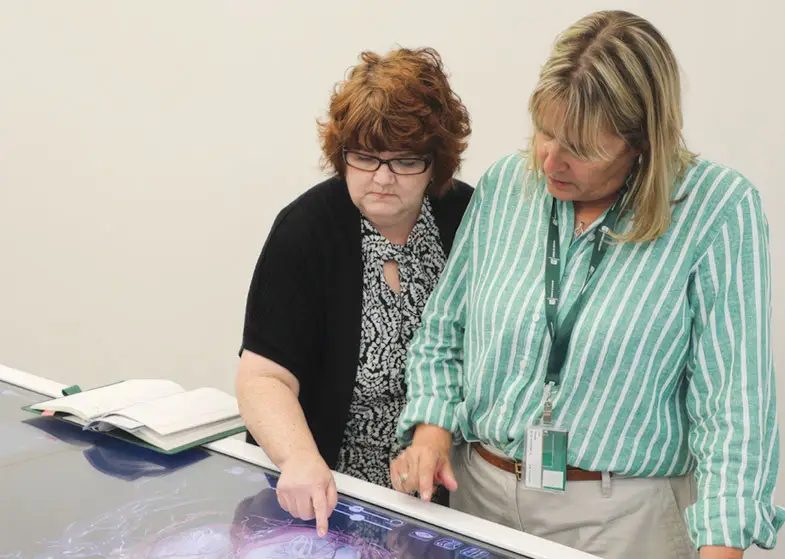
The program leverages the Table’s dual-screen capabilities to display both anatomical structures and physiological processes simultaneously. In one session, the students could visualize real nephron anatomy of the kidney on one side while concurrently seeing its blood flow, making invisible processes visible. “Cadavers provide anatomical insight, but they can’t demonstrate active physiological processes,” said Dr. Sossoman. “And that’s the Table. It’s just… we need a better word than amazing.”
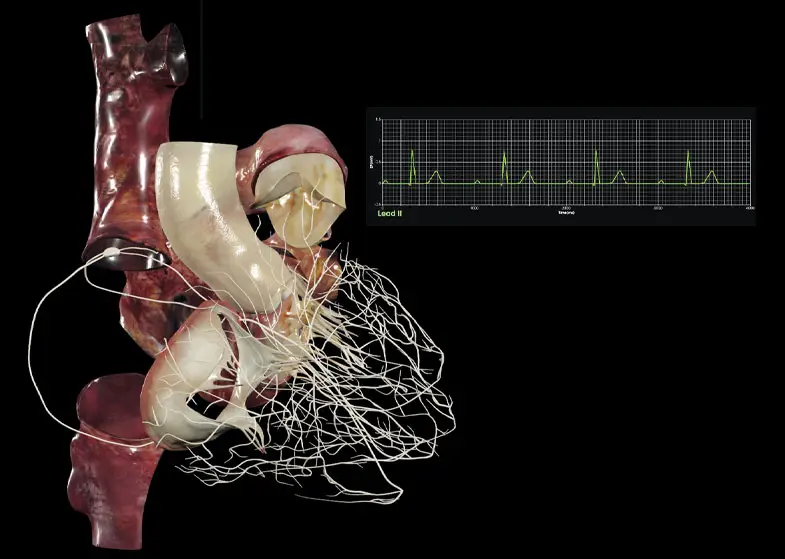
Faculty will sometimes integrate additional training technology, like positioning simulation mannequins adjacent to the Table. The tools pair well together when students study real-world scenarios, where they can examine heart valve anatomy, watch blood flow animations, listen to associated murmurs in the mannequin, and connect these elements to patient presentation in a single integrated experience.
The program also strategically incorporates clinical experts from Atrium Health, bringing sub-specialty advanced practice providers to demonstrate their expertise at the Table. These experts supplement textbook instruction by reviewing MRI scans, demonstrating procedures like cardiac catheterization, and assessing pathological findings. They even leverage student expertise: A student in the AG-ACNP program with experience in the neurointensive care unit co-taught a neurology session, demonstrating peer-to-peer learning and professional collaboration with the use of the Table.
With the Table, you're weaving in the pharmacology with the physiology and the anatomy so students can picture in their mind how that medicine works rather than just memorizing something. This is the application of knowledge.
Dr. Amy Winiger, Associate Graduate Faculty/Clinical Coordinator, AG-ACNP Program at UNC Charlotte
Results
Even with the Table’s full integration, the program’s faculty are continually looking for ways to expand their use of the Anatomage Table, viewing it not only as a teaching tool, but as an essential bridge between classroom education and real-world patient care. “We’re going to use it again next semester and find new clinical experts and new body systems to talk about in this case-based learning format,” shared Dr. Sossoman.
By strategically implementing the Anatomage Table within their case-based learning framework, UNC Charlotte’s AG-ACNP program has addressed critical gaps while preparing graduates to function as confident, knowledgeable members of interdisciplinary hospital teams. And as other advanced practice training programs look to improve clinical reasoning and enhance engagement, UNC Charlotte’s experience offers a compelling model for how integrating virtual 3D anatomy can elevate clinical education.
When [students] are in the healthcare team with physicians, physician’s assistants, pharmacists, and others, they can articulate the ‘why’ of what's going on with the patient and the pathophysiology of their disease processes, and the use of the Anatomage Table has helped us achieve this outcome.
Dr. LB Sossoman, Associate Graduate Faculty/Clinical Coordinator, AG-ACNP Program
Also at UNC Charlotte
Transforming Undergraduate Anatomy and Physiology at Scale
UNC Charlotte is leveraging the Anatomage Table far beyond graduate-level training. The Department of Applied Physiology, Health, and Clinical Sciences has integrated Anatomage technology in its undergraduate anatomy and physiology (A&P) courses, where faculty have recently redesigned the entire curriculum around interactive 3D anatomy, introducing both the Tables and Anatomage Tablets across lectures and labs. The technology now supports thousands of pre-health learners with hands-on visualization, stronger spatial reasoning, and early clinical confidence with complex structures. Students describe clearer “aha moments,” while faculty report significant improvements in comprehension and a more engaging, active learning environment. Together, the AG-ACNP program and A&P courses show how UNC Charlotte is building a unified, technology-driven foundation for health sciences education campus-wide.