

Case Study: UNC Charlotte A&P
Case Study:
UNC Charlotte A&P
Scaling Success: How UNC Charlotte Transformed Undergraduate Anatomy and Physiology Education for 1,400 Students Annually
Building a Technology-Enhanced Learning Environment that Helped Double Enrollment and Cut DFW Rates
In 2023, the Department of Applied Physiology, Health, and Clinical Sciences at the University of North Carolina at Charlotte recognized an opportunity to fundamentally reimagine its anatomy and physiology (A&P) curriculum. The program served approximately 600 students annually through traditional teaching methods, relying on textbooks, PowerPoint slides, and ineffective, outdated laptop-based software; however, like most A&P curricula across the country, the department struggled with high DFW (grades of D, F, and Withdrawal) rates and limited student engagement.
Their pre-health students — those aspiring to become physicians, physical therapists, occupational therapists, nurses, and more — needed deeper anatomical understanding to succeed not just in gaining admission to competitive professional programs, but in surviving the rigorous pace once accepted. And with their access to the Anatomage Table, the department had a scalable solution that could serve large undergraduate populations while providing the hands-on, interactive learning experiences that develop spatial understanding and long-term retention.
Challenge
A previous software solution, used jointly with biology, had also proved ineffective, leaving the department searching for alternatives. Additionally, DFW rates remained stubbornly high across both lecture and laboratory components. These grades not only damaged individual student trajectories but also raised concerns about how prepared students were for more rigorous instruction in advanced healthcare programs. “A lot of people understand it’s hard to get into medical school, physical therapy school, or occupational therapy school, but a lot of people don’t mention how hard it is to stay there,” said J.P. Barfield, Chair of the Department of Applied Physiology, Health, and Clinical Sciences at UNC Charlotte. “Professional schools lose 10, 15, 25% of their students in their first semester because students don’t have the skill set, even though they took the class. They don’t have ownership of the content.”
Scale presented another significant challenge. With hundreds of students in A&P courses each semester, the department needed solutions that could provide meaningful hands-on experiences and create active learning environments for larger groups. Additionally, the solution would also need to support diverse learning styles. “When I have 500 students in lecture, there are 500 individual learners,” shared Dr. Spencer Cain, a lecturer with the department. “That’s 500 different learning strategies. And that honestly makes my job impossible sometimes because it’s hard for me to figure out how 500 different people learn, and usually it’s different than how I learn, too.” All these factors contributed to the department’s search for a tool to bridge the gap between theoretical knowledge and real human anatomy, while supporting diverse learning styles and increasing student confidence.
Solution
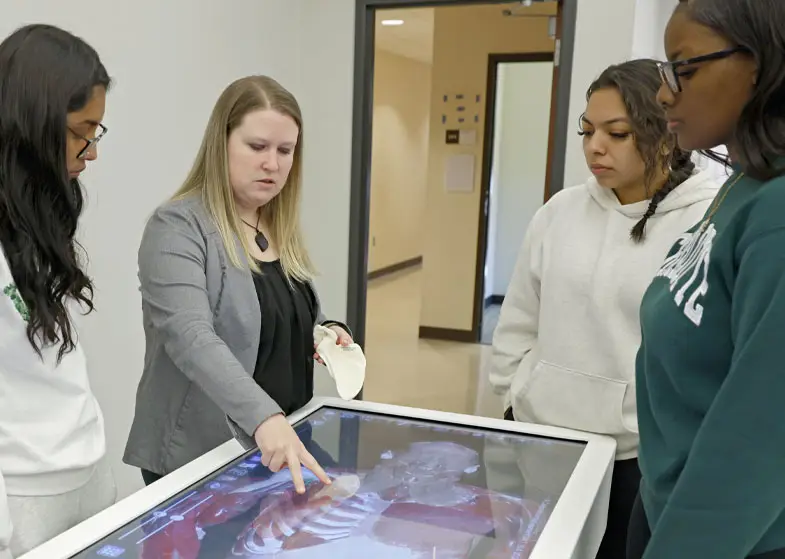
Dr. Cain uses the Table in nearly every lecture when discussing specific anatomical systems, sometimes abandoning her presentations entirely to use the Table as the primary visual reference. “The Table’s not going to replace traditional learning, but it is going to enhance it. It’s going to bridge that gap between theoretical knowledge and real human anatomy in an engaging way you can’t get from a PowerPoint.”
The laboratory curriculum leverages both Tables and Tablets to create structured, small-group learning experiences. Twelve Tablets remain permanently in the lab, providing consistent access for all lab sections. The department employs a rotation model where students cycle through three distinct learning modalities: traditional dry labs with anatomical models, virtual labs using software platforms, and Anatomage-based sessions. This variety maintains engagement while ensuring students spend focused time actively manipulating digital cadavers rather than passively watching classmates.
The introduction of Anatomage technology has also created more opportunities for hands-on student learning. The Tablets address a critical equity issue, enabling smaller lab groups where every student gets to work with their anatomy tools. “The benefit of the Tablets is you can have smaller groups working together,” shared Barfield. “It allows students to spend 100% of their time on learning.” The department even maintains structured open laboratory hours where students can access Tables with teaching assistant support outside scheduled class time, providing flexible study opportunities.
The depth of knowledge that students are getting is better than what we had before. The huge advantage for us with Anatomage is our students have a much richer understanding, and so the transition to professional school or a more intensive anatomy-based course is going to be easier.
J.P. Barfield, Chair of the Department of Applied Physiology, Health, and Clinical Sciences at UNC Charlotte
Results
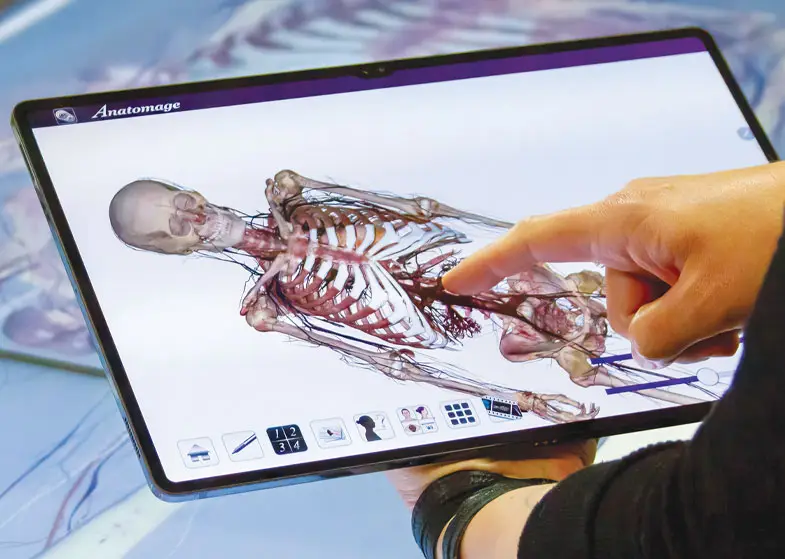
Student comprehension and spatial reasoning have improved markedly, with instructors observing fewer misconceptions about anatomical relationships and more sophisticated understanding of how structures integrate into whole-body systems. According to instructors, students report frequent “aha moments” when 3D visualization suddenly clarifies concepts that were opaque with 2D graphics. “Grasping the spatial awareness of things is so difficult to get with a student with a 2D image on a PowerPoint slide,” shared Dr. Cain. “It’s so difficult for them to get that spatial understanding of a three-dimensional structure until they get their hands on it. Trying to introduce that earlier or at least simulate that type of three-dimensional interaction earlier has been really helpful with the students.”
By strategically implementing Anatomage Tables and Tablets at scale with careful attention to pedagogical design, faculty development, and equitable access, UNC Charlotte’s Department of Applied Physiology, Health and Clinical Sciences has created a sustainable model for undergraduate anatomy education. They continue to serve diverse learners effectively while achieving measurable improvements in student success, engagement, and preparation for healthcare careers.
I really like [that the Table] is transformative and immersive, but also interactive and collaborative. I think it's really changed how students engage with anatomy. It all comes down to building confidence and students being comfortable and being able to discuss things.
Dr. Spencer Cain, Lecturer in the Department of Applied Physiology, Health, and Clinical Sciences at UNC Charlotte
Also at UNC Charlotte
Advancing Diagnostic Reasoning in Nurse Practitioner Training
Beyond undergraduate A&P courses, UNC Charlotte’s Adult-Gerontology Acute Care Nurse Practitioner (AG-ACNP) program also uses the Anatomage Table, elevating students’ clinical decision-making and diagnostic reasoning. Faculty have integrated Anatomage’s 3D real-human-based anatomy with case-based sessions, allowing students to visualize real patient scenarios, explore physiology and pathology side-by-side, and connect anatomy, physiology, and pharmacology in meaningful ways. The Table has become a cornerstone of their teaching model, helping learners articulate the “why” behind clinical actions and boosting confidence during hospital-based rotations. Together with the Department of Applied Physiology, Health, and Clinical Sciences, the AG-ACNP curriculum demonstrates how UNC Charlotte uses Anatomage technology to support learning from foundational anatomy to advanced clinical education.