

Case Study: Archbishop Stepinac High School

Case Study:
Archbishop Stepinac High School

Photo provided by Archbishop Stepinac High School

How Archbishop Stepinac High School Uses the Anatomage Table to Revolutionize High School Science

Building Confidence and Comprehension in Anatomy & Physiology and Beyond

Archbishop Stepinac High School introduced the Anatomage Table into its Health Sciences Honors Academy curriculum in 2021 to enhance Anatomy and Physiology (A&P) classes. Once implemented, the Table quickly became more than just a tool for one course, it transformed the science curriculum at Stepinac. The Anatomage Table now serves as a resource that engages reluctant learners, accelerates comprehension of complex scientific concepts, and provides high school students with educational opportunities typically reserved for graduate-level study.

Currently, the Anatomage Table is used across multiple levels of instruction at Stepinac, from introductory college preparatory biology for freshmen to advanced honors classes where students can earn college credit. The Table also supports individual student projects and case studies. By integrating the virtual cadaver and case studies into coursework throughout the science department, Stepinac has established the Anatomage Table as an essential teaching tool that promotes active, visual learning and builds student confidence.

Challenge

The Stepinac faculty faced a persistent challenge: making A&P courses engaging and accessible for students with varying levels of science background and confidence. Traditionally, instruction relied on digital textbooks, diagrams, and teacher-led lectures. While this approach facilitated memorization, it did not help students fully grasp three-dimensional structures, system interactions, or real-world clinical applications. Students intimidated by science often felt overwhelmed, which limited their confidence and participation in class.

As an all-boys Catholic school that transitioned to digital learning in 2009, Stepinac faculty recognized a gap between completing digital assignments and genuine comprehension. Veronica Smith, Science Teacher and Health Sciences Academy Coordinator, noted that even honors students sometimes just “cut and paste” without really absorbing the material. Teaching A&P at the high school level requires balancing rigor, accessibility, and engagement. Smith emphasized to her students, “Completion does not equate to comprehension.”

To improve student engagement and comprehension, Stepinac sought to address several barriers: First, freshmen arrive from various middle schools with different levels of science preparation, requiring faculty to scaffold lessons for emerging learners while maintaining rigor for advanced students. Second, traditional lecture-based instruction and digital textbooks lacked the visual reinforcement necessary for deep understanding. Third, Honors Academy students pursuing college credit needed support for accelerated learning without sacrificing academic rigor.

Solution
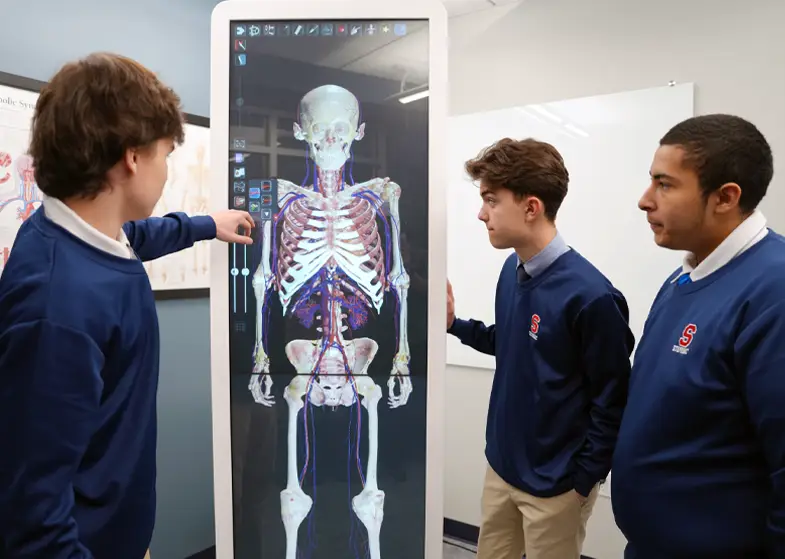
Stepinac began by integrating the Anatomage Table into their A&P laboratory classes, providing students with hands-on experience using virtual human cadavers, resources generally reserved for graduate students. After successful integration, faculty redesigned classroom spaces and instructional methodology to transform the Anatomage Table from a laboratory resource into a classroom tool for science courses. Now, during A&P class periods, the Table is available for instructors to incorporate 3D anatomy, station-based activities, exam preparation, and case-based learning into lectures.
Photo provided by Archbishop Stepinac High School
Students progress through all 11 major body systems, pairing each unit with clinical case studies that emphasize real-world applications. The Anatomage Table allows students to visualize structures in three dimensions, examine radiological images, explore physiological processes, and connect anatomy to pathophysiology. For instance, during skeletal and muscular units, students use labeling, annotation, and kinesiology features to study bone classification, joint movement, muscle origins and insertions, and biomechanical function. To further their understanding of the skeletal and muscular units, students then apply their knowledge to a case study to determine the disease or disorder a patient is presenting with and then determine a course of treatment for the patient. Instead of passively observing 3D structures, students work in small groups at the Table, rotating through stations to identify structures, explain form and function relationships, and teach concepts to one another. Smith described the students’ response: “They’re highly engaged with the Table, and their group work makes their mastery obvious — they teach, question, and learn from each other with real confidence.” Preset pins and timed activities are used for exam preparation and lab assessments, reinforcing comprehension and building technical proficiency.

The Table addresses the needs of students at different academic levels. Advanced Honors students move quickly through complex material, while emerging learners benefit from repetition, visualization, and guided exploration. For A&P students earning college credit, the Table supports the rigor required by universities while providing the structure needed at the high school level. Smith reported, “For students who approach the topic with hesitation or uncertainty, the Table has been transformative. It boosts their confidence, builds resilience, and ultimately supports stronger academic outcomes.”

Results
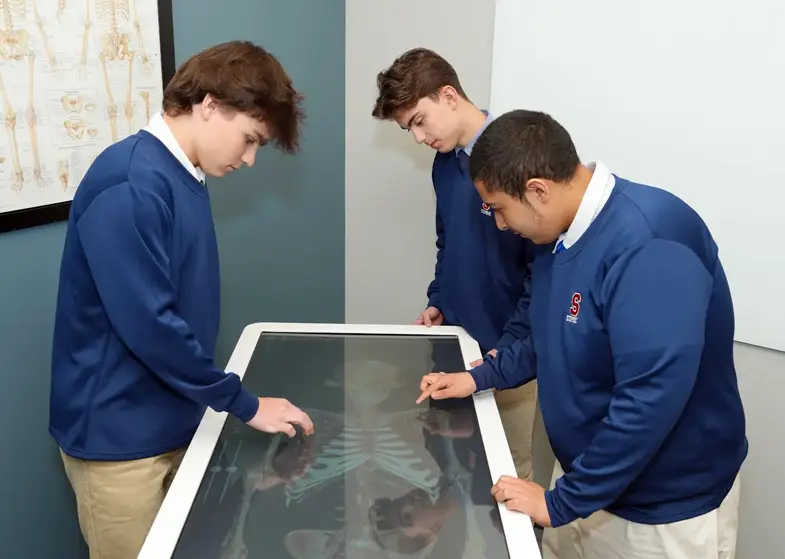
The integration of the Anatomage Table into the classroom has been transformative for students and faculty alike. Faculty observations confirm that integration of the Anatomage Table into the science classroom has resulted in students demonstrating a greater proficiency and confidence using the Table to navigate anatomical structures, as well as a stronger understanding of the spatial relationships between organs and structures, resulting in an increased fluency when discussing complex concepts and disease processes. Memorization is now a smaller component of the academic equation. Students are building a deeper understanding of anatomical structure and function over time, while connecting terminology and clinical relevance through hands-on, student-led learning at the Table. Students who once felt intimidated by anatomy now approach the subject with more confidence, seeing themselves as capable learners.
Photo provided by Archbishop Stepinac High School
The combination of visual, auditory, and motor learning pathways utilized in this new approach to the high school A&P classroom, made possible by the Table, supports diverse learning styles and reinforces comprehension that cannot be achieved through simple task completion. At Stepinac, the Anatomage Table has become a catalyst for student engagement, equity, and real-world learning. By using digital 3D anatomy in the classroom, students gain tools that encourage advanced integrative thinking and set a new standard for A&P education at the high school level.

Also at Stepinac

Expanding Interactive Learning Across the Science Curriculum
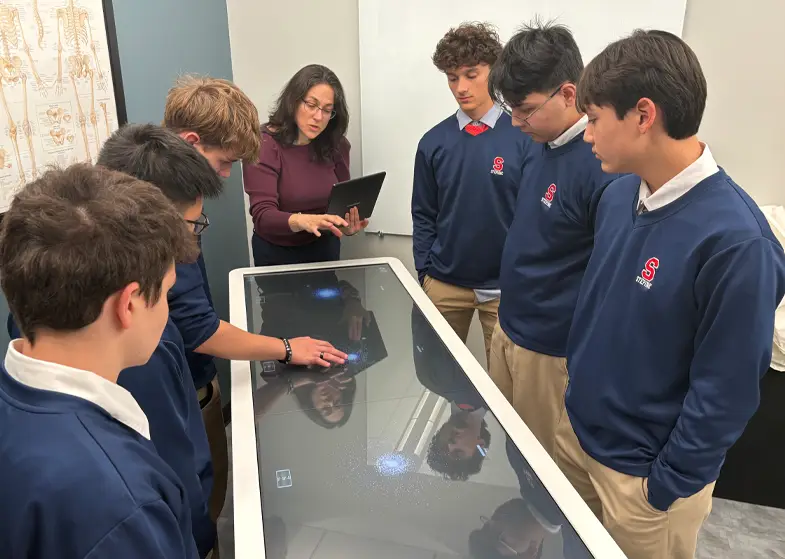
Photo provided by Archbishop Stepinac High School
In 2024, after successfully integrating the Anatomage Table into the A&P classroom, Stepinac expanded its technological investment by adding Anatomage’s Science Table. This software provides experiments for Biology, Chemistry, Earth & Space Science, and Physics, providing advanced digital labs and accompanying digital worksheets that exceed traditional virtual lab capabilities. The Science Table has enabled Stepinac faculty to apply the same interactive approach from A&P to additional disciplines in the science department, strengthening instruction of foundational science concepts by allowing instructors to use realistic 3D experiments to reinforce core topics. The Science Table is used in Biology to reinforce cellular structure and genetics lessons. It has also been introduced to the chemistry classroom to demonstrate abstract concepts such as the probability maps made by atomic orbitals, a challenging abstract concept translated into a clear visual model students can manipulate on the Science Table. The platform has also made a debut in the physics classroom to demonstrate Newton’s Laws of Motion and force vectors in a low friction environment demonstrated by a virtual air table activity. Looking ahead, the Science Table will be used to enhance student learning in the Advanced Placement Psychology course in the upcoming academic year.

Stepinac has established a cohesive learning experience that connects foundational biology, advanced anatomy, chemistry, and physics. The addition of the Science Table has ensured that all their science students have access to engaging, student led, high-quality science instruction that supports long-term academic growth.

Connect with Anatomage