

Poll Question Splash Page
This Week's Anatomy Quiz
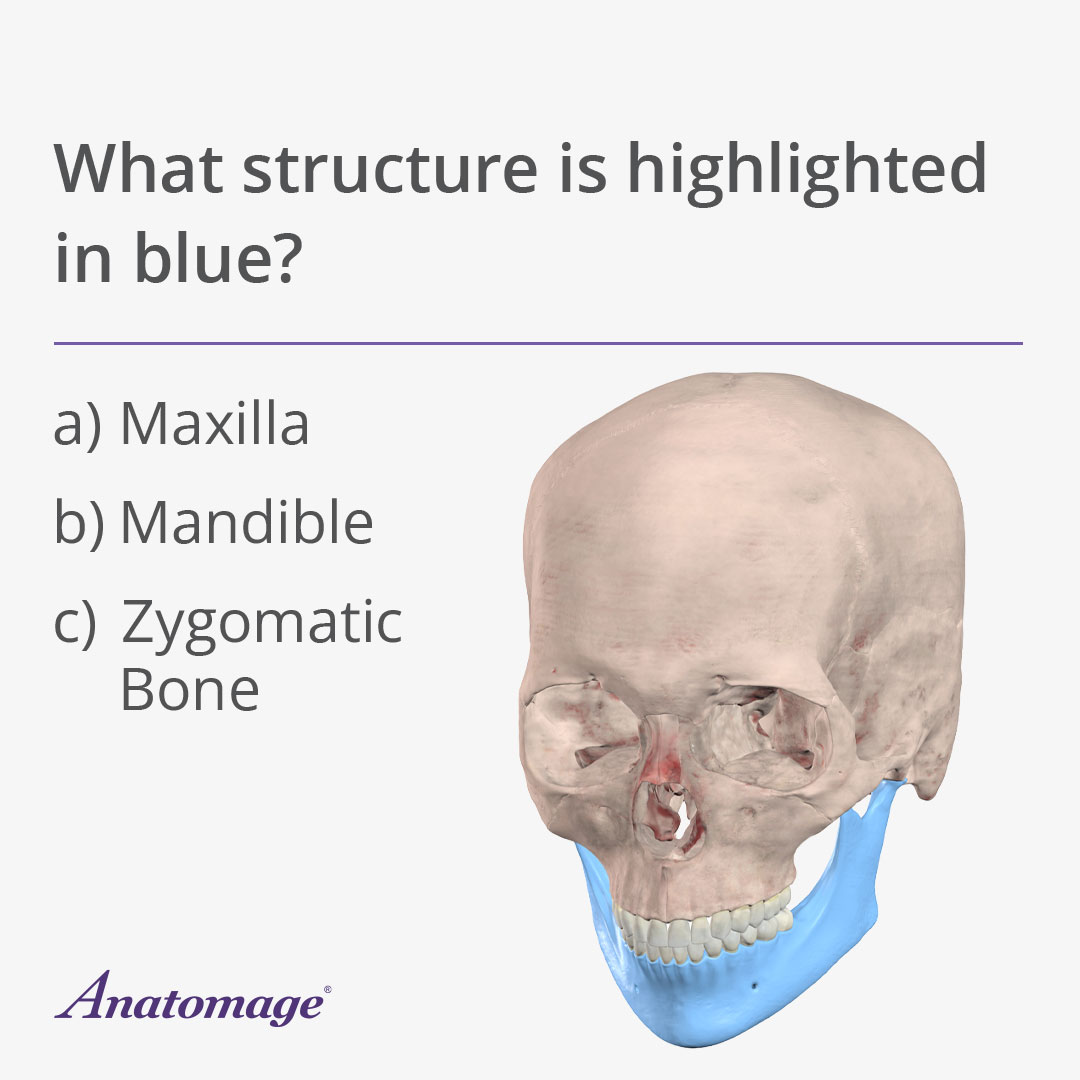
Answer:
b) Mandible
The mandible, or lower jawbone, is the largest and strongest bone of the face, playing an important role in chewing, speaking, and supporting the lower teeth.
Fun fact: The mandible is the only moveable bone in the skull, moving at the temporomandibular joints (TMJs) to open and close the mouth.
Anatomy Quiz Archive
Roll over or click on the archived quizzes to see the answers.
Answer:
a) Diaphragm
This dome-shaped muscle separates the thoracic (chest) cavity from the abdominal cavity and plays a major role in breathing.
Fun fact: The diaphragm changes shape as you breathe, flattening during inhalation and relaxing back into a dome shape during exhalation.
Answer:
a) Cerebellum
Want to ride a bike, play an instrument, or learn a new sport? These activities all rely on the cerebellum, which helps control balance, coordination, and precise movements.
Fun fact: Even though it only makes up 10% of the brain’s volume, the cerebellum contains more than half of the brain’s neurons.
Answer:
b) Clavicle
The clavicle, or collarbone, is the long bone that connects the shoulder to the sternum, which helps support arm movement and stabilize the shoulder.
Fun fact: It’s actually the only bone that connects your arm to the rest of your skeleton.
Answer:
c) Femur
The femur, AKA your thigh bone, is the longest and strongest bone in the human body. It connects the hip to the knee and supports much of your body weight.
Fun fact: Anthropologists have developed an equation to estimate a person’s height based on the length of the femur, used when studying skeletal remains.
Answer:
c) Endocrine
The endocrine system is a network of glands that produces and releases hormones. These help regulate body functions like growth, metabolism, and mood.
Fun fact: You know when stress or a surprise can set off your body’s “fight-or-flight” mode? That response is actually triggered by adrenaline, which is produced by the adrenal glands in the endocrine system.
Answer:
b) 27
The adult human hand contains 27 bones: 8 carpal bones (wrist), 5 metacarpal bones (palm), and 14 phalanges (fingers).
Fun fact: Almost half of the bones in your entire body are located in your hands and feet combined.
Answer:
c) 12
The thoracic spine is the middle section of the vertebral column, made up of 12 vertebrae (T1–T12). It helps to support the rib cage and protect the spinal cord.
Fun fact: The thoracic section of the spine has a natural curve (called a kyphotic curve) that helps distribute body weight and maintain posture.
Answer:
c) Lateral
In anatomical terms of location, lateral describes position away from the middle of the body.
Fun fact: In anatomy, “lateral” and “medial” are opposite terms: Medial describes position closer to the body’s midline, and lateral means away from the midline. For example, the nose is medial to the eyes, and the eyes are lateral to the nose.
Answer:
c) Iris
The iris, the colored part of your eye, controls how much light enters by adjusting the size of the pupil: It gets smaller in bright light and larger in the dark to help you see clearly.
Fun fact: Iris patterns are unique and differ from person to person, just like fingerprints!
Answer:
a) Pancreas
The pancreas plays a vital role in controlling blood sugar by producing the hormone insulin. Insulin moves glucose from your bloodstream into your cells, where it’s used for energy.
Fun fact: The pancreas is technically part of both the digestive system and the endocrine system; it produces enzymes to help digest food and hormones to regulate blood sugar.
Answer:
a) Ilium
The ilium is the largest of the three bones (alongside the pubis and ischium) that are fused together to form the hip bone. The ilium serves to bear weight and help support the spine.
Fun fact: The human ilium’s shape allows our gluteal muscles to attach at points that keep the body balanced and stable when walking. In fact, scientists can tell if an ancient species walked on two legs by looking at its ilium — shorter, broader ilia are an indication of bipedalism.
Answer:
b) 11
The 11 major systems are the Integumentary, Skeletal, Muscular, Nervous, Endocrine, Cardiovascular, Lymphatic, Respiratory, Digestive, Urinary, and Reproductive systems.
Fun fact: Chronic stress can affect every system. It can slow digestion, weaken immunity, increase heart rate, mess with hormones, and even shrink the brain.
Answer:
b) Heart
The respiratory system enables your body to take in oxygen and remove carbon dioxide. The trachea, or windpipe, acts as the main airway, carrying air from the nose and mouth into the lungs, where it branches into the bronchi. These tubes direct air into each lung so oxygen can reach the deeper parts of the respiratory system.
Fun fact: Your left bronchus is narrower and longer because it has to curve around the heart, which slightly tilts into the left lung space.
Answer:
a) Jejunum
The jejunum is the middle section of the small intestine, located between the duodenum (first) and the ileum (final). It plays a critical role in digestion by absorbing nutrients like sugars and amino acids from food. Its inner walls are lined with circular folds and tiny hair-like projections called villi for better absorption.
Fun fact: The jejunum makes up about 40% of the small intestine — it’s packed into your abdomen and could stretch to about 8 feet when uncoiled.
Answer:
a) Cervical
Located in the neck, the cervical spine is the uppermost part of the spinal column. It supports your head, protects your spinal cord, and allows for a wide range of head and neck movement. However, despite its flexibility, the cervical spine is also highly vulnerable to injury due to its location and mobility.
Fun fact: Both humans and giraffes have the same number of cervical vertebrae: seven. (Giraffes’ neck bones are just much longer!)
Answer:
a) Heart rate
An ECG (electrocardiogram) records the electrical signals in your heart that trigger heartbeats. Each heartbeat produces a wave pattern, and the ECG can track the timing between waves, thus calculating your heart rate.
Fun fact: While a normal resting heart rate typically ranges from 60 to 100 bpm, athletes can have lower rates due to stronger heart efficiency — as low as 30 bpm!
Answer:
c) Pituitary gland
This pea-shaped endocrine gland sits behind the bridge of your nose, below the hypothalamus; it’s responsible for the production and release of several hormones that contribute to important bodily functions, including growth, metabolism, and response to stress.
Fun fact: The pituitary gland is often referred to as the “master” gland because it controls the function of many other glands in the endocrine system.
Answer:
b) Tendons
These bands of connective tissue allow movement by transferring the force created by muscles.
Fun fact: The largest tendon in your body? The Achilles tendon, which connects your calf muscles to your heel.
Answer:
b) Filters all of the blood
These bean-shaped organs filter waste and extra fluid from the blood to produce urine and help keep the body balanced.
Fun fact: Each kidney contains about a million microscopic filters called nephrons, which remove waste from the blood.
Answer:
c) Skin
The skin is the body’s largest organ, forming a protective barrier that helps regulate temperature, prevent infection, and sense the world around you. The average adult has about 20 square feet (nearly 2 square meters) of skin.
Fun fact: The outer layer of your skin sheds and replaces itself about every month.
Answer:
a) Gallbladder
This small organ is located beneath the liver, and it stores and releases bile to help digest fats.
Fun fact: You can live without your gallbladder. If it’s ever removed, bile flows directly from the liver into the small intestine.
Answer:
b) Arteries
Arteries are blood vessels that carry oxygen-rich blood away from the heart to deliver oxygen and nutrients throughout the body.
Fun fact: The body’s largest artery is called the aorta, and it carries blood directly from the heart to the rest of the body.
Answer:
a) 206
The adult human body contains 206 bones that help provide structure, protect organs, store minerals, and work with muscles to create movement.
Fun fact: Babies are born with about 270 bones, many of which fuse together as they grow.
Answer:
b) Brain
The thalamus is a small structure deep within the brain that sends sensory information to different parts of the cerebral cortex.
Fun fact: Nearly all sensory information, except smell, travels through the thalamus first.
Answer:
c) Tibia
The tibia, or shinbone, is the larger and stronger of the two lower leg bones, supporting most of the body’s weight during standing and movement.
Fun fact: The tibia is the second-largest bone in the body; only the femur is larger and stronger.
Answer:
a) Anterior
The anterior view is based on the standard anatomical position: standing upright with palms facing forward.
Answer:
Ear
The stapes, located in the middle ear, is the smallest bone in the human body and helps transmit sound vibrations to the inner ear for hearing.
Fun fact: The stapes is only about 3 millimeters long (smaller than a grain of rice).
Answer:
Liver
The liver, which filters blood and produces bile, can regenerate lost tissue and regrow after damage or partial removal.
Fun fact: The liver is your body’s largest internal organ.
Answer:
Pancreas
The pancreas is a glandular organ that produces digestive enzymes and hormones like insulin to help regulate blood sugar and support digestion.
Fun fact: The pancreas is part of both the body’s digestive system and the endocrine system.
Answer:
Left
The heart is located slightly left of the center of the chest, between the lungs, where it pumps blood throughout the body to deliver oxygen and nutrients.
Fun fact: The left lung is slightly smaller to make room for the heart.